Winners of the Henry van de Velde Awards 2026
Zoals elk jaar bekronen de Henry van de Velde Awards producten, projecten, diensten en systemen van ontwerpers en bedrijven uit Vlaanderen die met doordacht design een positieve impact hebben op economie, omgeving en samenleving. Een vakjury selecteerde binnen negen categorieën de winnaars van de meest prestigieuze designprijzen van België. Among this year's winners are our Designer in Residence Kato Herbots with her project Residents of Solar Space, Revor Group from Kuurne with its circular and modular bed frame Neonest, and ABBY Kortrijk.
These are the Henry van de Velde Award winners in the project categories:
1. Business Innovation
Borro - Sim system for reusable cups
Design agency: Borro BV (Antwerp)
Partners: Re-uz, Seeder, Imec Istart, IPB, Sjef, Weeze, Adyen, CCV
Easy Checkout
Design agency: Superellipse (Mechelen)
Client: Colruyt, in collaboration with Smart Technics and Superellipse
NEARGRID compact
Design agency: MAXIMALdesign (Antwerp), Superellipse (Mechelen)
Client: NEARGRID
2. Consumer
Easy Wheely
Design bureau: Wannes Van Laerhoven / Easy Wheely (Kortenberg)
Partners: Zorglab Aalst, CrossCare 2.0 Interreg Vlaanderen-Nederland
RuTM Booster
Design bureau: Studio Gooris (Hong-Kong)
Client: Bombol Limited
SmartGames IQ Deluxe Editions
Design bureau: Smart Toys & Games (Kontich)
3. Crafts by Bokrijk
The lost jewels of Queen Louise-Marie d'Orléans
Designers: Charlotte Vanhoubroeck (Ghent)
Partners: Hasselt University, PXL-MAD School of Arts, Research Foundation - Flanders (FWO-Vlaanderen)
This project was selected in 2020 for our exhibition WE ARE THE NEXT GENERATION at Broelkaai 6 Kortrijk during the WONDER Creativity Festival.
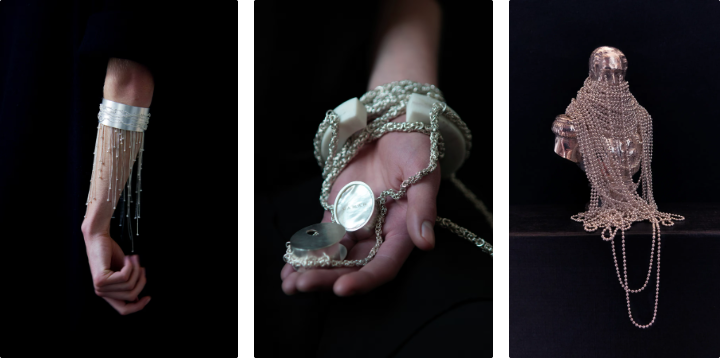
Charlotte Vanhoubroeck (°1991, Ghent), jewellery artist and art historian, researched the lost sentimental jewellery of Louise-Marie d'Orléans, the first Queen of Belgium (1812–1850). The jewellery (including miniature portraits, engraved messages, locks of hair, etc.) was lost, meaning that it can now only be studied through archive descriptions. Based on thorough art-historical and artistic research, Charlotte reactivated the jewellery and created new objects that bring Louise-Marie's emotional world to life in a contemporary way.
Porcelain Dawn
Design agency: Middernacht & Alexander (Aalst)
Shifting Colors
Designer: Esther Van Schuylenbergh (Bruges)
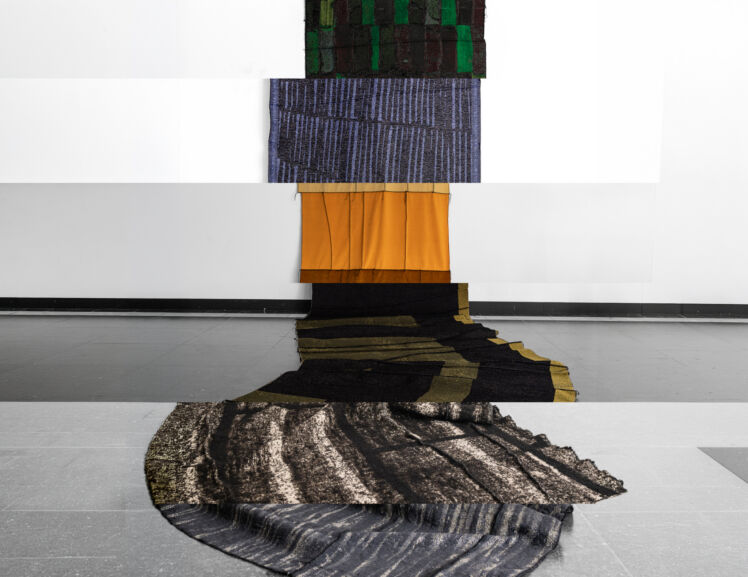
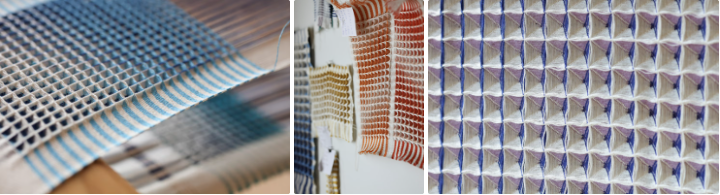
Shifting Colours is a series of woven panels that combines traditional craft techniques with digital design tools. Subtle shifts in colour and texture create fluid colour transitions that break through the repetitive nature of dobby weaving. On a hand loom, warp threads can vary in material, density and weft, enabling new interactions between colour and texture. The result is a playful and monumental series of panels in which small geometric patterns unfold into unexpected, dynamic gradients.
Esther participated in our BIND Collective exhibition at the Budafabriek Kortrijk during the WONDER Creativity Festival in 2022.
4. Design Research
Decentering Design - Practice in a More-than-human World
Design bureau: Onderzoekscentrum Futures through Design van de School of Arts Gent, Art Paper editions / Jurgen Maelfeyt BV
Partners: Howest - Digital Design & Development (Devine)
Client: HOGENT
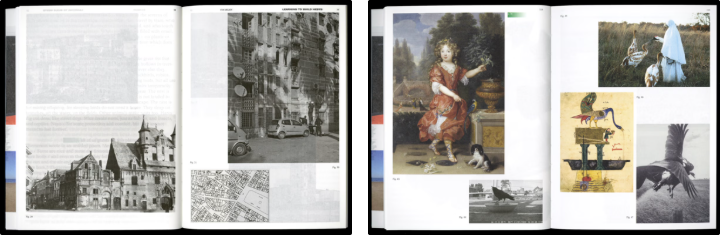
Decentering Design is a research-through-design project that explores how design can contribute to an inclusive future by no longer placing humans at the centre, but understanding them as part of a more-than-human network. The project challenges designers and artists to open up their processes to other forms of presence, knowledge and agency through small, non-linear working methods that are both method and result. These exercises are compiled in the publication Decentering Design: Practice in a More-than-human World and offer tools for reflection and action, stimulating a shift in design thinking from anthropocentric to relational, ecological and multispecies-oriented.
Residents of Solar Space
Design bureau: Kato Herbots (Velm)
Partners: Dermatologist Maselis, B&T Textilia, LUCA Product Design Genk, LUCA Textiles Ghent, Ghent Industrial Museum, Marianne Winten, Johanna Seelemann and Niek Kosten for their support.
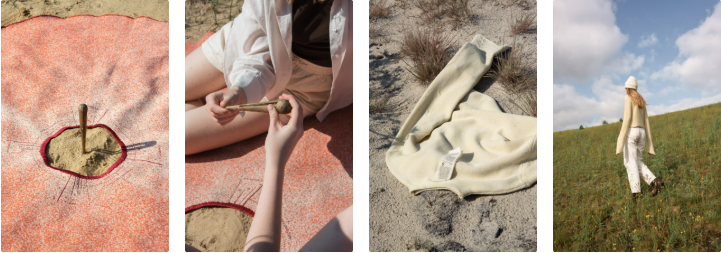
Residents of Solar Space investigates how design can contribute to a healthier and more conscious approach to the sun. Whereas today we turn to sunscreen to protect ourselves from too much sunlight and to dietary supplements to compensate for a lack of sunlight, this project explores alternative materials and objects that restore our natural relationship with sunlight. A sun sheet with an integrated sun (bathing) indicator provides insight into vitamin D production and safe exposure time based on UV index and skin type. A UV-transparent PLA jumper keeps you warm while still exposing you to the necessary sunlight.
The discourse surrounding the sun and health is highly polarised; the sun is often considered to be either exclusively good or bad. With my project, I wanted to introduce nuance and demonstrate that it is both, depending on factors such as time, UV intensity, skin type and context. My focus on materials came naturally. I work from a strongly material-driven design practice and believe in the power of materials, both functionally, discursively and narratively. Materials make abstract ideas tangible and enable us to shape new ways of relating to the world.
City without a Postcode
Designer: Franne Lefever (Hertsberge)
5. Digital Design
Rubens Experience
Design bureau:Wondering BV (Gent)
Partners: Create.eu (multimedia),Bruns (maatwerk, vitrines, meubilair en interactieve opstellingen), Chris Pype (Licht)
Client: Het Rubenshuis (Antwerpen)
Shared Memories
Design bureau: Joey Kissen & Jens Demarest (Gent)
Walden BOX
Design bureau: Walden BOX (Kruibeke)
Partners: Verhaert
Client: Walden Group
6. Environment
Essens Circular
Design bureau: Samsonite Europe N.V. (Oudenaarde)
Partners: Aarova, LyondellBasell, Circularise
Neonest
Designbureau: Superellipse (Mechelen)
Client: REVOR GROUP (Kuurne)
Neonest is a circular and modular bed frame made from 100% recycled material, which, thanks to its circular design and innovative click and upholstery system, offers a sustainable alternative to traditional wooden or metal frames. Thanks to its mono-material design, the frame is fully recyclable after use and offers a sustainable alternative to traditional wooden or metal beds. With patented features such as Neoconnect, Neohold and Neocord, we have developed an innovative click and slide system that allows the frame to be easily assembled and disassembled without tools. Upholstery can be easily attached and replaced, ensuring that the product will last for years, both visually and functionally. The design thus combines circularity, flexibility and long-lasting aesthetics.
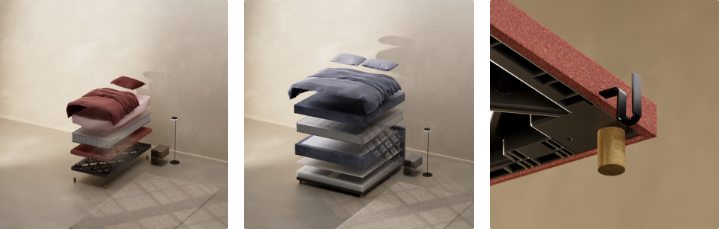
Neonest is the world's first circular bed frame made entirely from post-consumer recycled plastic. Neonest proves that high-quality products do not have to come at the expense of the planet, but can actually contribute to a closed, circular economy.
WVDM Living Lab
Design bureau: MAKER architecten (Gent)
Partners: Origin architecture & engineering, VK architects & engineers, VITO, Beneens
Clients: VUB (Vrije Universiteit Brussel)
7. Graphics
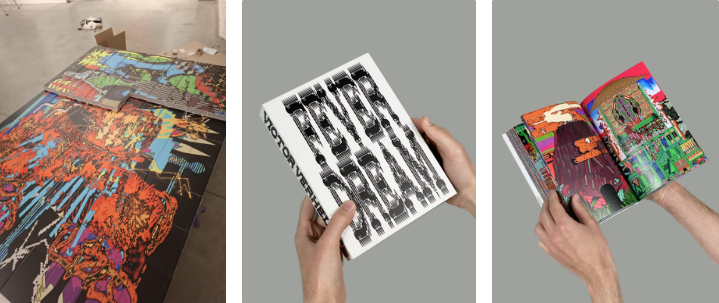
Fever Dream - Victor Verhelst
Design bureau: Studio Corbin Mahieu (Gent), Victor Verhelst (Gent), Lennart Van den Bossche, Type Designer: Ilya Koers
Partners: Fedrigoni Special Papers, Albe De Coker, PLUS-ONE Projects, Sidequest
The aim of this unique portfolio book is to blur the boundary between book printing and art and to create a work of art that goes beyond a fleeting coffee table book.
The book brings together five years of work by digital artist Victor Verhelst in a unique object that blurs the line between book printing and art. With a specially developed variable font, new Fedrigoni paper and innovative digital printing technology, the result is an almost 500-page oeuvre in which typography and visual experimentation come together. Each copy is unique: the back cover shows a fragment of a monumental work of art created for this project. The complete work only becomes fully visible when all the books are placed together during the opening of the solo exhibition at the Plus One Gallery, making the portfolio book itself part of a larger work of art.
Kunsthal Gent
Design bureau: Kunsthal Gent
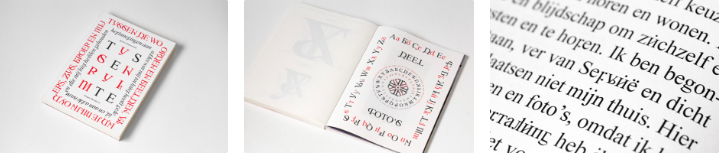
‘Tussenruimte’
Design bureau: Dragan Marinkovic (Roeselare)
Times New ROMA is a typeface that unites Latin and Cyrillic. It brings two worlds together and reflects the experience of immigrants and refugees by connecting the two. Due to immigration to Belgium from Serbia (2011), Dragan's parents and he himself had to learn to read and write a new alphabet. This inspired him to design an alphabet that is readable for both those born and raised in Belgium and people from Serbia. It reflects the alienation and confusion often experienced when navigating a new language and culture. The project links typography to stories of migration, offering a tangible way to bridge the gap between two worlds.
Tussenruimte was selected and exhibited in 2024 at WE ARE THE NEXT GENERATION in the Budafabriek Kortrijk, at the WONDER Creativity Festival.
The jury said of this project: 'Tussenruimte is a poetic and personal project that focuses on the experiences of immigrants and refugees. It brings together the Latin and Cyrillic scripts in a beautiful publication and a new typeface. In doing so, it succeeds in building a bridge between two worlds through design and raising awareness. The project gave the jury goosebumps. We see here a new talent making a convincing entry into the world of graphic design and typography.'
8. Habitat
FERRATA
Design bureau: Dorien Eeckhout (Deurne) & Jonas van Put (Antwerpen)
POOK
Design bureau: Jeff Rutten Objects (Tessenderlo)
Partners: Jan Verheyen
Scrap Chair
Design bureau: ROVER project (Aalst)
Partners: OptimaT, MetalClean, Voortzettende Opleiding Meubelontwerp (Thomas More Mechelen)
The SCRAP Chair is a circular garden chair made entirely from industrial waste streams from Flemish industry. The project is based on a dual ambition: to rethink waste as a raw material and to create a fully-fledged, aesthetic piece of furniture that does not compromise on comfort or quality.
The seat reuses residual sheets with authentic perforations from punching processes, while the frame consists of bent and welded reinforcing steel. Designed for indoor and outdoor use, the chair combines a timeless, robust silhouette with comfort and aesthetics. The first edition of 50 pieces was produced by custom manufacturer OptimaT and can be personalised in any RAL colour.
The SCRAP Chair was exhibited at the WONDER Creativity Festival 2025.
9. Spaces
Abby Kortrijk
Design bureau: Tab Architects BV (Gent), Barozzi Veiga (Barcelona)
Client: Stad Kortrijk
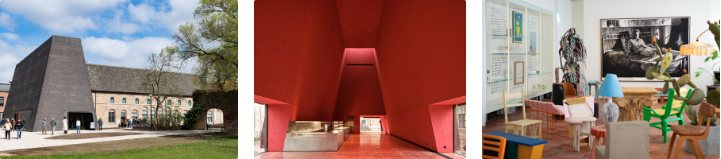
Abby Kortrijk is a unique, playful and accessible museum for visual arts, which, with its innovative 'Stadsliving' concept, questions what a museum can and should be today, for whom and by whom. With 'Stadsliving', Abby introduces an innovative museum concept: an accessible open house that is draped around the classic museum rooms like an experimental outer shell and functions as a third space in the heart of the city, where visitors, creators and local communities come together, share programmes and develop participatory projects. The museum builds bridges between art, heritage and design, and redefines the concepts of ownership and presentation. Every two years, Stadsliving is designed by a different artist; in the first edition, Rinus Vandevelde created furniture, houseplants and lamps from cardboard, wood and paint, as a nod to Kunstwerkstede De Coene (1888-1977).
The aim was to create a new kind of museum: an open and versatile place, a 'house with many rooms' in the wonderful setting of the Beguinage Park. With subtle interventions, the new architecture enriched the history of the site and gave it space for the future: an ideal setting to present art as a mirror of our layered, changing and deeply rooted identities.
Genk op Gang
Design bureau: Studio-tic (Genk), HET LABO vzw (Hasselt), Depot Roel Vandebeek (Maasmechelen)
Client: Stad Genk
GPG - Toren voor Dier en Mens
Design bureau: URA Yves Malysse Kiki Verbeeck (Brussel)
Partners: Denkbar (structuur), Sweco Belgium NV (masterplan), Driekwart Groen (natuurinclusief bouwen)
Client: Agentschap Natuur en Bos i.s.m. Stad Gent
Save the date
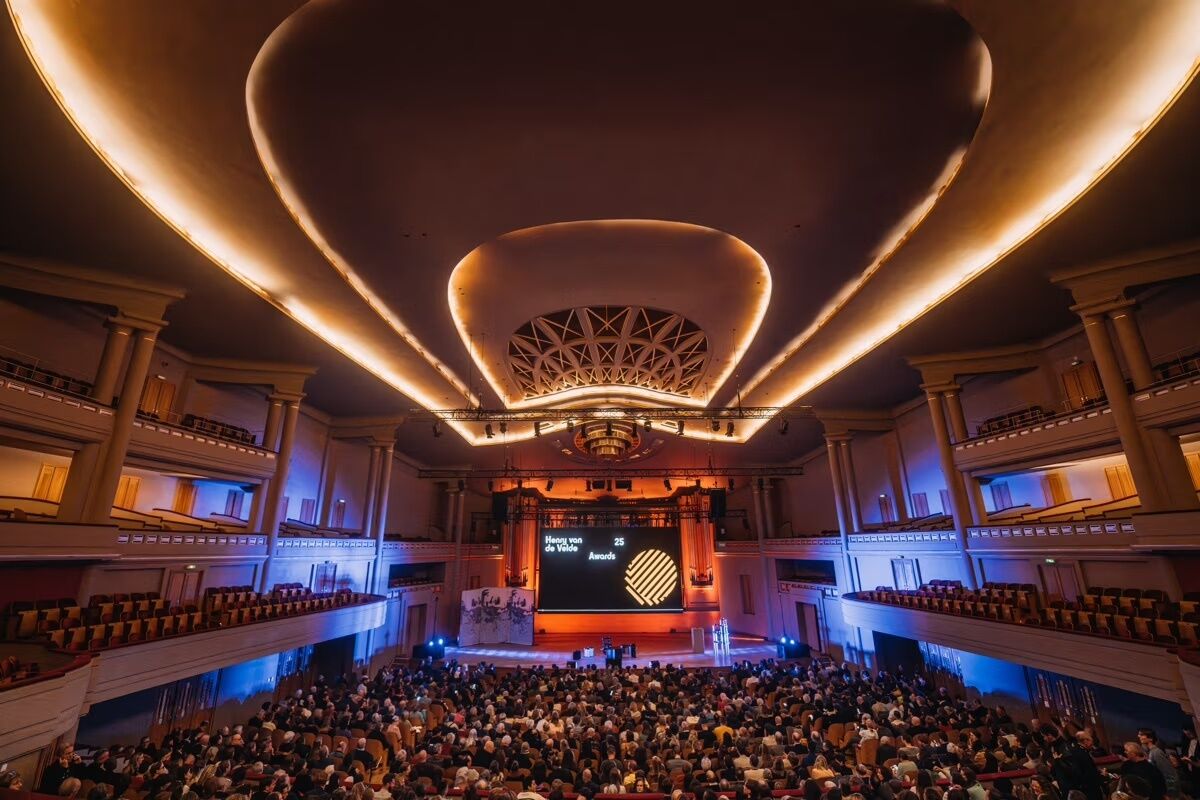
On 27 January 2026, the festive award ceremony will take place at Bozar in Brussels, where all winners of the Henry van de Velde Awards 26 will be announced. On stage, the Gold, Silver and Bronze Awards will be presented in nine project categories: Business Innovation, Consumer, Crafts by Bokrijk, Design Research, Digital Design, Environment, Graphics, Habitat and Spaces.
In addition, the winners of the Lifetime Achievement, Young Talent, Company, Ecodesign by OVAM and Public Gold Awards will also be honoured.
From 27 November onwards, interested parties can register to attend the ceremony.


Lisa Declercq
Lisa is responsible for Designregio Kortrijk’s offline and online communications. She also coordinates the WONDER Festival alongside Stan. She is always on the lookout for the next big thing in young design talent and is therefore helping to build the organisation’s creative community.